the energy systems
There are so many different ways to exercise and move your body. Regardless of whether you’re an athlete that has a strict training plan, including weights and strenuous conditioning, an everyday gym-goer, or a ‘weekend warrior’ your body is still using its energy systems to ensure you can exercise the way you want to.
In your lifetime you might have heard the words Anaerobic and Aerobic…
Anaerobic means ‘without air’ and is the way your body produces energy without oxygen. The energy that is generated is Adenosine triphosphate (ATP). This energy is very short-lived, usually lasting 2-4 seconds. ATP- PC ( phospho-creatine) will then kick in and can last up to 10 seconds. You may be thinking “but I do a high-intensity workout for longer than 10 seconds. How does that work?” In simple terms, multiple energy systems can be used at a time, one is just more dominant. As well as this the ATP in the skeletal muscle can be replenished pretty quickly when your body is at rest, so when you start another burst of intense exercise it is there to be used again.
Alternatively, you have aerobic exercise, not to be confused with the 90’s exercise trend aerobics! Although yes, this form of exercise would use the aerobic system, aerobic simply defines any form of exercise that requires oxygen to create energy in a continuous manner. Your aerobic system typically lasts up to 2 hours.
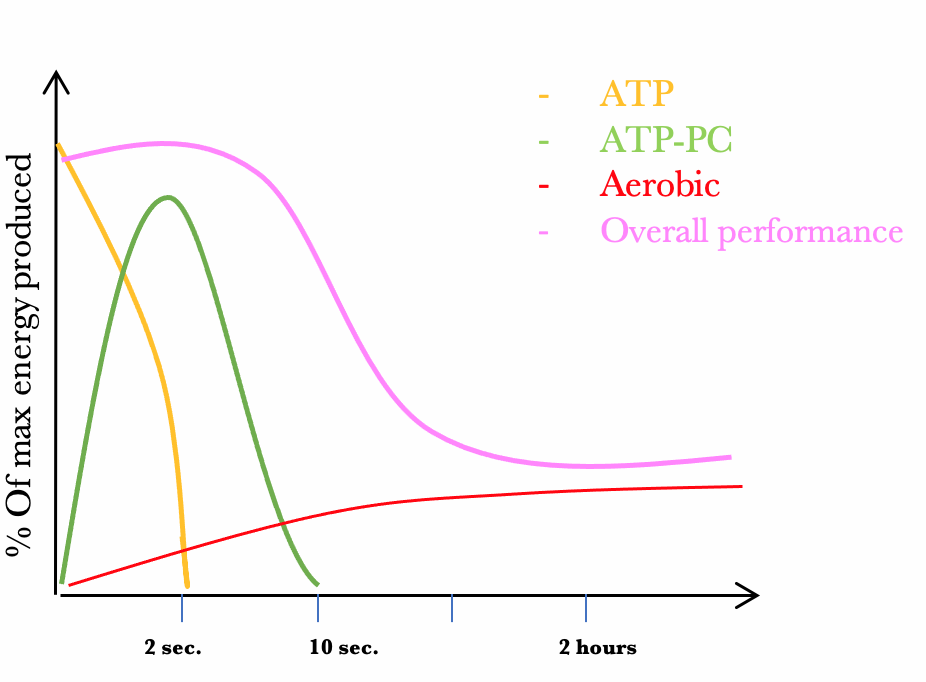
To put the timing of systems into a visual this graph illustrates how the different systems are dominant at different times throughout exercise. Specifically looking at ATP, ATP - PC, and the Aerobic system.
HOW CAN I BECOME AEROBICALLY FITTER?
Let’s say you want to run a marathon or even just be able to run a couple of km’s without stopping ( very relatable 😅). Often when we talk about someone being ‘fit’ it’s endurance that sets them apart from others.
There are a few points that can result in improving your aerobic fitness, I’ll just bullet point them for now…
- Firstly you can become fitter aerobically by doing anaerobic training. Implementing methods like interval sprints, Tabata and other HIIT variants can improve the efficiency of your cardiovascular system and VO2 max, meaning you can utilize maximum amounts of oxygen during exercise.
-You have to get comfortable with being uncomfortable! I’m no long-distance runner but, I know first-hand that this is easier said than done. Pushing your physical limit past the ‘comfortable’ zone each time will slowly improve your fitness and aerobic endurance.
- The last tip that has been discussed more recently in research papers ( but definitely can’t hurt to include) is strength training. The increase in muscle mass can improve oxygen economy and a focus on mobilisation and force will make aerobic endurance that little bit easier. If the endurance type you are trying to improve is running, the extra muscle mass will help carry your body throughout the long run as the force produced is increased, aiding in forward movement at each stride.
SO… DO DIFFERENT SYSTEMS REQUIRE DIFFERENT ENERGY SOURCES?
The short answer is no your body will still produce energy with any energy source or macromolecule being either Carbohydrates, Fat, or Protein.
Some systems have a preferred source to provide the most efficiency. If you are sprinting or using your anaerobic system dominantly while eating a very low carb diet you will most likely see impaired time, or performance as carbohydrates are used to produce ATP quickly. With a lack of carbs, your body would go into ketosis which will break down fat to use as energy, but usually at a slower rate. However, for moderate to lower intensity exercise, which will favour the aerobic system predominately, performance will most likely be maintained with any fuel source.
As a general rule, your body will use any fuel source it has to provide you with energy. It’s what you find feels the best when your exercising and recovering that works best for you.
THE FACTS:
Patel H, Alkhawam H, Madanieh R, Shah N, Kosmas CE, Vittorio TJ. Aerobic vs anaerobic exercise training effects on the cardiovascular system. World J Cardiol 2017; 9(2): 134-138 [PMID: 28289526 DOI: 10.4330/wjc.v9.i2.134]
Hoff J, Gran A, Helgerud J. Maximal strength training improves aerobic endurance performance. Scand J Med Sci Sports. 2002 Oct;12(5):288-95. doi: 10.1034/j.1600-0838.2002.01140.x. PMID: 12383074.