Pros and cons of Caffeine
Is coffee a morning ritual for you? Or maybe even a morning, midday, and afternoon ritual…? Coffee has its benefits but also its downfalls. I agree a barista-made coffee can’t go a miss, especially an iced oat milk latte! However, too much caffeine in your diet might be what’s making you feel lethargic each day, you’ve then got to ask yourself if that 3rd daily coffee is still benefiting your health, or hindering it?
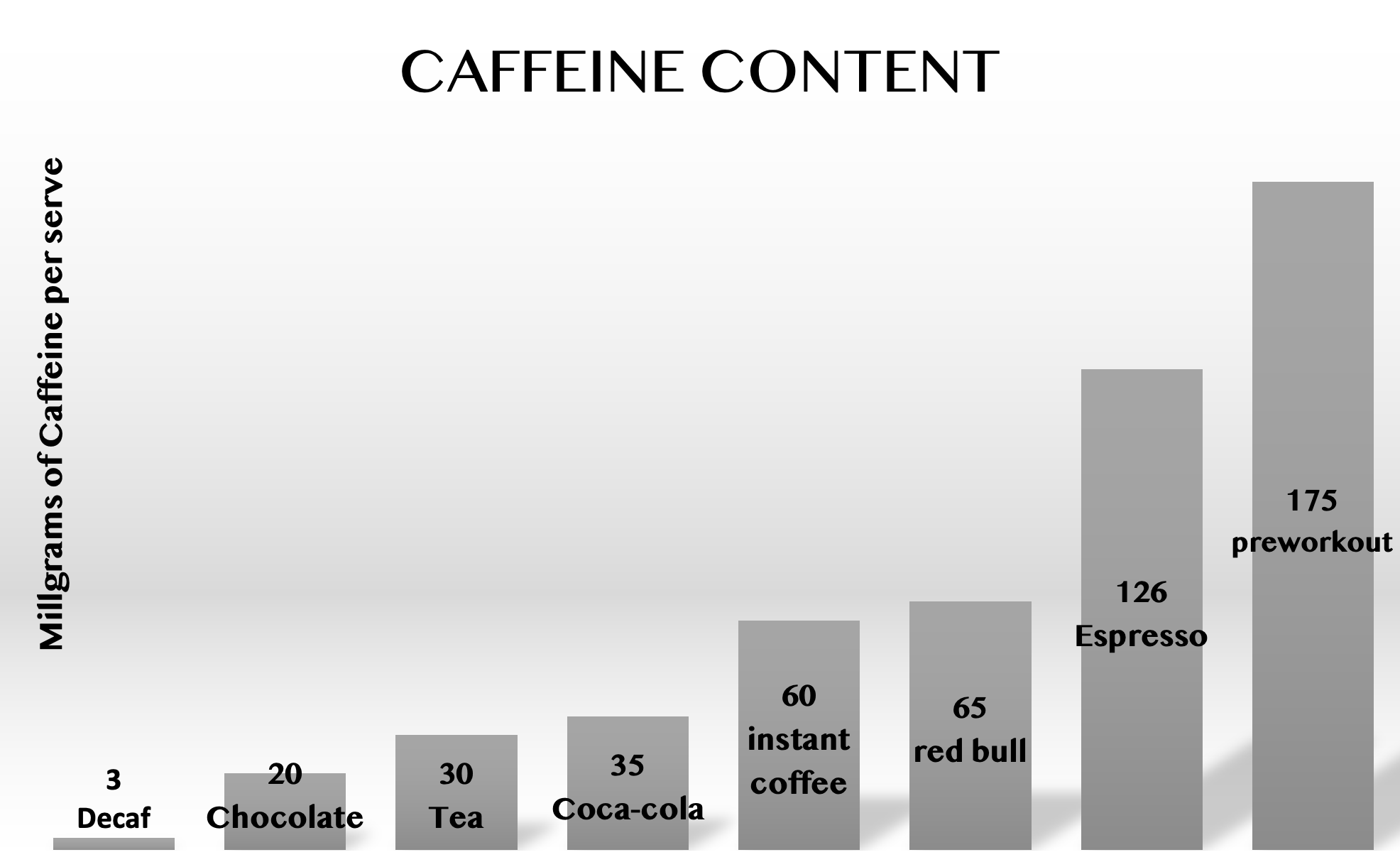
Caffeine is found in many drinks and some food products. Such as coffee, tea, Coca-Cola, energy drinks, pre-workout, and chocolate. – This graph gives a great visual of just how much caffeine is found in particular things.
First things first; a backstory on caffeine. In western society 80% of the adult population consumes caffeine making it the most widely used psychoactive drug. Although of course not a dangerous or illicit drug it still has addictive properties to the substance. Before coffee became popular people would drink alcohol to start the day –greatly hindering productivity, as you can imagine. With caffeine people were able to bio-hack their circadian rhythm to get more done at any time of day without fatigue kicking in.
The way caffeine works…
In your body, you have adenosine receptors, which usually bind to adenosine. Adenosine slowly builds up and slows down the activity of neurons, making you feel tired. (I know this sounds science-y but stick with me). When caffeine is consumed the molecules look similar to adenosine, so it can bind to the adenosine receptor leaving no space for adenosine to bind. In turn, this speeds up your neural pathways… This then results in the effects that we all know from caffeine, like the perception of more energy, increased heart rate, and mental alertness (to name a few).
How caffeine and coffee can benefit you…
Caffeine, when appropriately dosed, can be extremely helpful for focus, performance, and energy levels. For students, night shift/early morning workers, and athletes coffee has changed the way they can operate and perform whether that be mentally or physically.
Coffee is essentially calorie-free so can be useful for those people wanting to slightly decrease their caloric intake and still enjoy coffee for all its benefits. Although it needs to be said that coffee should never be had in place of a meal or just to decrease your appetite, if you’re hungry your body needs a substantial food source to use as energy.
Both coffee beans and tea leaves are the most antioxidant-rich beverages. Coffee having 200–550 mg/cup, and tea has 150-400mg. Antioxidants are another topic I could expand but simply put, antioxidants neutralise free radicals in your body. These are naturally produced from the metabolism of foods but also exposure to toxins, tobacco, and UV light. So antioxidants can reduce the risks of some diseases, cancers, and heart disease.
Coffee and tea are also great drinks to get a natural source of caffeine without all the additives, both are derived from plants so the chemical properties are completely safe for your body and naturally occurring.
What’s wrong with having too much caffeine?
The main downfall to caffeine is sleep. Seems obvious, but you might be thinking, ‘I sleep fine after I drink caffeine, no matter what time of day’ but your sleep is still being affected. You might still fall asleep easily but your sleep efficiency is decreased, affecting your deep slow-wave sleep and REM ( rapid eye movement) sleep. Your deep sleep is where your body repairs cells, releases a lot of important hormones and proteins, and of course, restores energy. Not getting adequate deep sleep often causes the vicious cycle of waking up feeling more tired than when you went to sleep. Similarly, some people experience the ‘daytime caffeine crash’ where they rely on coffee almost continuously or every few hours in order to stay alert and awake. This feeling is caused by the caffeine wearing off and adenosine starting to bind, the sudden build-up of this can make you feel super sleepy all at once. This becomes an issue for people that need to be awake for work, uni, or family commitments, which is pretty much everyone. Caffeine addiction then becomes a very real part of a person’s day (don’t get me wrong there are far worse things to be addicted to, but it can still cause withdrawals and negative side effects to your health).
Pre-workout…
Although pre-workout could be a whole topic itself, it’s important to note just how much caffeine content it has. A single-serve of Pre has on average 175-200mg of caffeine. Almost 3x the amount in a standard cup of instant coffee. Where this becomes harmful to other aspects of your health is people taking more than the suggested serving size or taking in way later in the day when they decide to go to the gym. As you’d imagine this can disrupt sleep even more. While you might not care about sleep and will deal with the consequences if you go to the gym to improve strength, grow muscle, or lose fat, sleep is so crucial to ensure your body recovers. If your sleep is constantly disrupted the chances are that your entire body is not recovering as well as it should be to gain these physical benefits.
So what can I do to decrease my caffeine content?
There’s nothing wrong with having a cup of coffee every day but if you feel as though you consume too much caffeine just to function or fewer cups of coffee might improve your health there are a few tips to stay on top of your intake:
1. Make one decaf – if you have more than one coffee per day try to start by making one decaf. It might not taste exactly the same but you can still enjoy a regular coffee at another time during the day.
2. Go caffeine-free on your days off, if you rely heavily on caffeine, a Monday morning might not be the best time to go cold turkey if you find it necessary for functioning at work. However on those slower days, like the weekend you could go caffeine-free and see how your body reacts.
3. Find an alternative. I’m not going to sit here and say a glass of ice water can substitute coffee. Because it just can’t. But it’s beneficial to find another drink you enjoy. Tea can a good alternative with 2-4x less caffeine than coffee. Chai tea or chai lattes, matcha is also a very popular alternative at the moment. Or, if you struggle with needing 2-4 cans of Coca-Cola or Red Bull each day maybe you could swap to caffeine-free options ( like lemonade or kombucha) in order to decrease the overall caffeine your consuming.
4. Change your routine. This is easier said than done, depending on your job, but if you need caffeine from a lack of sleep make it a priority to get to sleep an hour earlier each night. Or consume caffeine ‘strategically’ so instead of having one at 8 am and another at 12 pm, just have the one coffee at 10 am and see how your body adapts to it.
Facts/Findings:
Marshall Brain, Charles W. Bryant & Matt Cunningham "How Caffeine Works" 1 April 2000.
Damiani E., Astolfi P., Carloni P., Stipa P., Greci L. (2008) Antioxidants: How They Work. In: Valacchi G., Davis P.A. (eds) Oxidants in Biology.